Introduction
Highway work zones are some of the most challenging environments to manage safely. Every cone, barricade, and sign must follow strict placement guidelines set by agencies like the Virginia Department of Transportation (VDOT). These Temporary Traffic Control (TTC) devices play a critical role in ensuring both driver and worker safety—but verifying their placement is often a manual, time-consuming process.
In April 2018, my team set out to explore how IoT and cloud technologies could make this process smarter, faster, and more reliable. Over a two-month period, we developed a proof of concept (PoC) and minimum viable product (MVP) to test the business and technical feasibility of an automated system for managing work zone safety devices.
The Challenge
In VDOT maintenance operations, compliance with safety standards requires daily inspection of all traffic control devices. Field crews manually check whether each cone or barricade remains within the established safety parameters.
As project lengths increase—sometimes spanning several miles—these inspections become more resource-intensive and less consistent. The problem grows exponentially with larger sites, leading to higher operational costs and potential safety risks if devices are misplaced or overlooked.
We asked ourselves a simple question:
Can technology automatically verify that every cone is in the right place—without human intervention?
The Solution
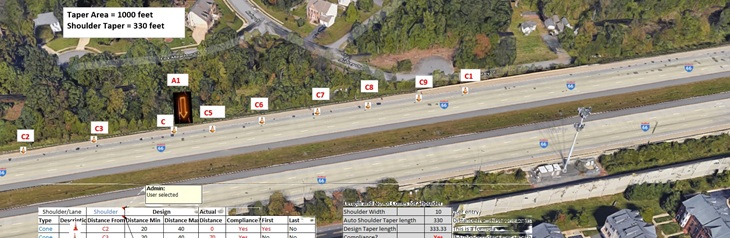
We designed and implemented a low-power IoT solution to automatically track and verify cone placement in real-time.
The architecture leveraged cloud-based asset tracking technology from Airgain, combined with Microsoft Azure services for data ingestion, visualization, and alerting. Each cone was equipped with a small IoT tracker capable of transmitting its location via LTE to the cloud.
The MVP included:
- A real-time dashboard displaying all cones on a map.
- Device onboarding and management tools.
- Standard MOT (Maintenance of Traffic) templates for common road configurations.
- Automated alerts and notifications using Twilio when devices drifted out of compliance zones.
This end-to-end setup allowed supervisors to instantly see whether cones were correctly placed—reducing the need for physical inspection rounds.
Architecture Overview
The PoC architecture combined Microsoft Azure cloud services, IoT connectivity, and a modern web interface for visualization.
Key technologies included:
- Azure Cloud for hosting and IoT data ingestion.
- Verizon Cloud & LTE for wireless connectivity.
- Redis Cache and Tile38 for high-speed geospatial data processing.
- Bing Maps API for mapping and visualization.
- .NET and MS SQL for backend logic and data management.
- Angular and Freeboard for the dashboard frontend.
- Twilio for SMS notifications.
The result was a highly responsive, low-latency system capable of tracking multiple devices and providing instant compliance feedback.
Results and Impact
The PoC successfully demonstrated that IoT-enabled compliance tracking is both technically feasible and operationally valuable for traffic control management.
Key takeaways included:
- Proof that real-time device visibility can drastically reduce manual inspection efforts.
- A working model that can be scaled into a full-fledged Smart Work Zone Management System.
- Valuable insights into low-power IoT architecture and geospatial data handling on Azure.
While the project was an early-stage exploration, it laid the groundwork for future connected infrastructure initiatives—where roads, equipment, and safety systems communicate intelligently to protect workers and save time.
Conclusion
This project showcased how cloud architecture, IoT, and modern web technologies can address long-standing safety and operational challenges in public infrastructure management.
By transforming a manual inspection workflow into a data-driven system, we proved that even traditional industries like road maintenance can benefit from digital transformation—one cone at a time.
Comments are closed